Diving With The Citizen “Challenge Diver” Fujitsubo 35th Anniversary
Wait, The Bezel Is Bright Blue & The Whole Thing Is Coated With Platinum?
The well-told story goes that in 1983, a Citizen Challenge Diver washed up in good working order on Long Reef Beach in Sydney, Australia. Produced in 1977, the watch spent roughly six years among the waves, emerging encrusted within a barnacle or fujitsubo in Japanese. A recent marketing graduate’s dream, Citizen wove the tale into the 2022 release of a new Challenge Diver-inspired reissue now known as the Promaster Fujitsubo. Positioned above many of Citizen’s Promaster divers including the legendary Aqualand at $1,195, the Fujitsubo was presented in Citizen’s proprietary Super Titanium and powered by a 4 Hz automatic caliber from Miyota.
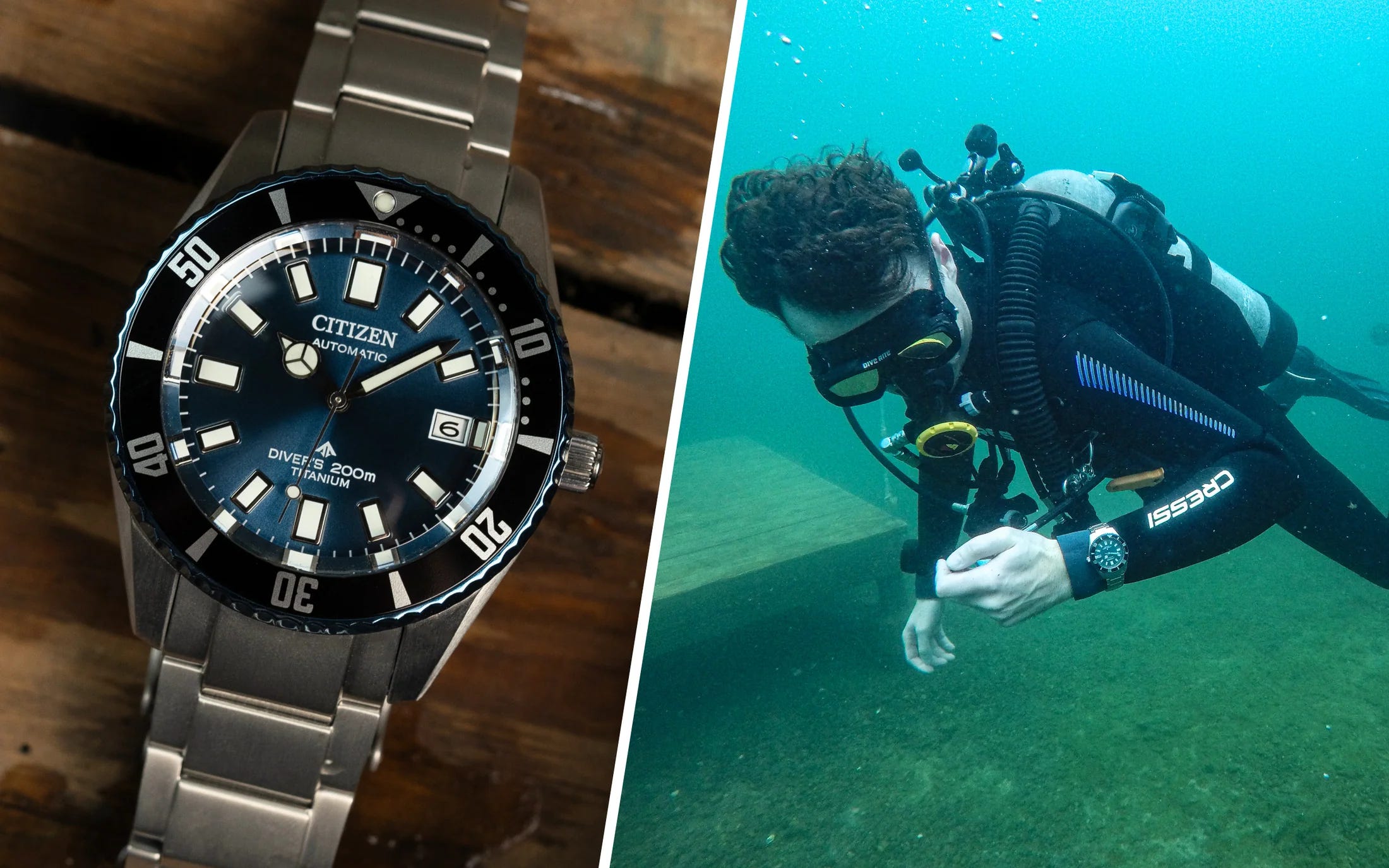
Fast forward a couple of years, and in celebration of the 35th anniversary of the Promaster collection, Citizen unveiled an intriguing new variant of the Fujitsubo with a truly novel anodized blue bezel and a platinum DLC coating for its titanium case and bracelet. Say what you want about the new design, it is undeniably different, but is different a good thing? In this edition of the Dive Log, I’ll share my experiences living and diving with the Fujitsubo 35th Anniversary, a watch that unapologetically stands out from a sea of vintage-inspired divers afraid of descending too deeply into the unknown.
Citizen’s Heritage-Inspired Diver
It almost doesn’t need to be said at this point, but if you’d like to introduce a successful new dive watch or any other watch today, it helps to start with a heritage design “from the archives”, an approach that favors brands that have been around. The success of watches like the Tudor Black Bay in the entry-to-luxury tier or something like the Seiko SPB143 on the more affordable end are great examples of the trend. Citizen is no spring chicken, having produced its first pocket watch in 1924, but the brand’s diving collection didn’t kick off in earnest until the Challenge Diver’s introduction in the early 1970s, well after many undersea icons. Given the hype around reviving old designs, it’s almost surprising it took Citizen until 2022 to go after this design, but I digress.
As the pages of the Dive Log will attest, I’ve long been a fan of Citizen’s dive watches, having used them extensively in the military, as a commercial diver, and later for recreational scuba diving. When the Fujitsubo was announced, I was stoked. While I agreed with criticisms saying the bezel’s action was just ok and the crown was on the small side, the titanium build, 4 Hz Miyota caliber, and faithful recreation of the original design were still enough to warrant a closer look. If anything, the regular version could have been accused of lacking pizazz. When I saw the funky new 35th-anniversary Fujitsubo earlier this year, resplendent with pizazz, I knew I needed to get the watch on the wrist and into the water.
Design & Build

Before we get wet, let’s take a closer look at the watch’s high points. To start, the case measures 41mm in diameter, 48.9mm in length, and 12.3mm thick, wearing in many ways like a full-size Tudor Black Bay, with fixed bracelet end links that extend the perceived lug to lug at least a bit. On my 6.5” (16.5cm) wrist, the Fujitsubo wears well, but part of me—my wrist, specifically—wishes Citizen had maintained the original version’s 40mm diameter and closer to 47mm lug-to-lug, especially for a watch that feels in many ways designed for enthusiasts. Encased in Citizen’s Super Titanium, the watch is also extremely light.
The platinum DLC coating makes this titanium watch look more like steel if not even brighter, but the real reason you’re here is the bezel, which is anodized with a striking shade of electric blue. It’s a polarizing aspect, but my argument would be that if you want a watch that looks like all of the other watches, this one was never for you anyway. Some have been hard on the bezel action with this model family and while I agree there are watches better in this department in the price range, this example operated well with 60 muted but effective clicks. Another area of beef is the crown, which is screw-down and complete with a Promaster logo but surprisingly small at 5.4mm. It’s not hard to work with, but I would argue it throws the proportions off just a bit given the 41mm case diameter.
Between the crown and screw-down caseback with its snazzy 35th-anniversary motif, the Fujitsubo is good for 200 meters of water resistance and complete with ISO 6425 certification. Set between 20mm lugs, the 35th is equipped with a bracelet that, despite a few challenges, is excellent for diving. With a three-link format, pin-adjusted links, and a few hits of polishing, the bracelet looks great, especially in this DLC Platinum format. My central qualm is with the clasp, which, while it looks the part and integrates a slick diving extension, is also mighty long at 49.4mm, and indeed longer than the watch itself.
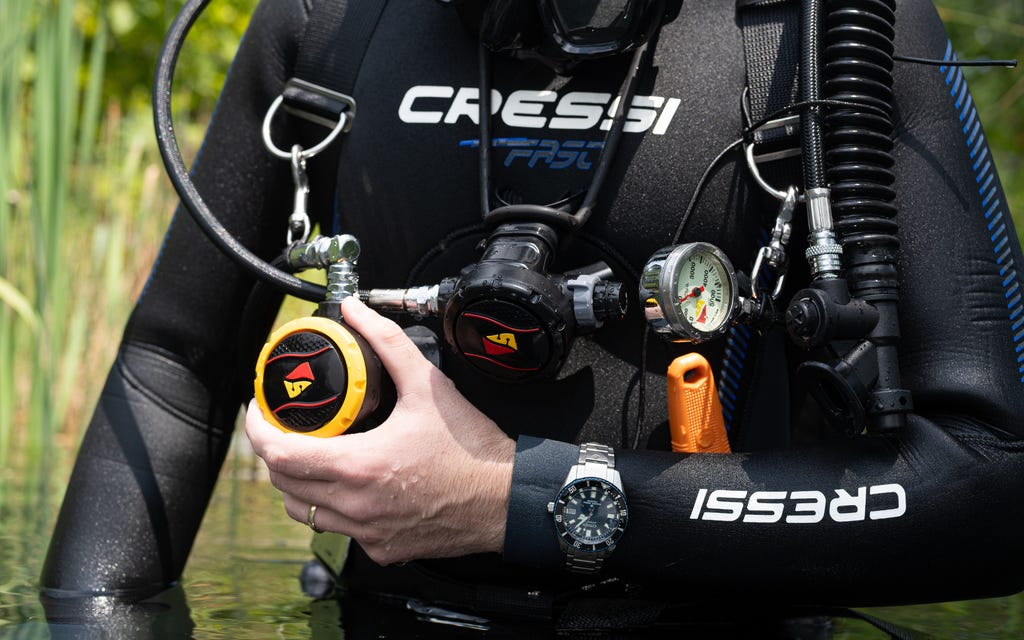
While you could theoretically use the diving extension to fine-tune the fit, the clasp lacks traditional micro-adjustment other than a welcome pair of half links. Still, a perfect fit may come down to luck for some, and those of you with smaller wrists may be annoyed by the clasp. I was able to make it fit well enough with a half link, and the extension does work well for use over a wetsuit, but I still wore the watch on a Five Eye strap from Watches of Espionage most of the time.
For me, the dial is great, staying close to the original design while making room for modern finishing standards. Citizen opted for a greener shade of luminescent material that keeps the vintage vibe alive while falling short of some other Citizen divers in its performance. Some may take issue with the use of a Mercedes hour hand on this design as it closely resembles many Rolex models, but that aspect has been a part of the Challenge Diver since the 70s and it only makes sense Citizen opted to retain it here.
The last piece of the puzzle is the movement. Citizen is in the fortuitous position of also owning Miyota, one of the world’s largest producers of movements both quartz and automatic. The majority of Citizen’s automatic dive watches to date rely on 8000-series Miyota calibers operating at 3 Hz, which could be called the standard Japanese frequency. This model, which the brand positions as elevated above watches like the Fugu, uses a 9000-series caliber, the 9051 in this case, operating at the Swiss standard of 4 Hz, right in line with something like the ETA 2824 or a Sellita SW200. The stated accuracy standard is not incredible at -10 to +20 Sec/Day—though this example kept much better time—and the power reserve is a relatively unimpressive 42 hours.
Ok, Let’s Go Diving
Whether you’re a dedicated Seiko fanboy or a longtime Rolex diehard, it’s tough to deny Citizen’s underwater capabilities, and this Fujitsubo is no different. There are perhaps more hardcore diving designs from the brand including the aforementioned Aqualand or something like the Fugu, but what is cool about the Fujitsubo is that the watch strikes a balance between refinement, heritage inspiration, and utility as a diver. Wading into the crystal clear waters of a quarry in rural Virginia, I wanted to see firsthand how the watch held up underwater.
As I mentioned, the clasp’s integrated extension was excellent, easily accommodating a wetsuit without any added fuss or aggravation as I geared up. Rotating the bezel to mark the beginning of my descent, the dial held up well enough in deeper water, but the thick chamfer around the edge of the flat sapphire crystal coupled with less-than-amazing anti-reflective coating meant the Fujitsubo did its best work when viewed head-on. It was a bright sunny day, and the luminescent material was doing its thing in an especially charming way with its green shade as I ducked under a section of floating dock into relative darkness. Back in the shallows, the diffused sunlight illuminated the blue anodized bezel and almost white DLC platinum coating. Even underwater, this version of the Fujitsubo is “built different” as the kids like to say.
Like most well-made ISO-certified dive watches from major brands, the Challenge Diver performed well in a real diving scenario, underlining the intriguing blend of refined heritage looks and genuine utility I mentioned earlier. Still, I’m not naive. I understand the majority of desk divers have no intention of taking this watch or any other deeper than the hot tub at the Holiday Inn Express outside O’Hare, but that isn’t why we’re here. At least for me, a major part of what makes a dive watch great is the relationship between how it looks and its intended use case, with each element serving a specific purpose that reaches back into the earliest days of underwater timing.
Of course, there are more pedestrian-looking dive watches out there that get the job done without such extreme stylistic choices as a bright blue anodized bezel. But it’s important to remember that in 2024, almost no one dives, meaning the very act of scuba diving has at least an element of counterculture. Whether you dive or not, if you’re worried about standing out with a solid dive watch from a legendary brand in the space, I would argue, why the hell not give it a try? You have your whole life to wear boring dive watches, and you might even have some fun in the process.
If you enjoyed this article, please be sure to follow us on Instagram and check out our website for Submersible Wrist gear and more content.
Thanks to Brock Stevens (@deepsea.edc) for the photos in this edition of the Dive Log and to Jacob Van Buren (@sea_vue) for his modeling efforts with the Citizen Barnacle.